Skip to product information
1 of 3

"ISOG have continually under-promised and over-delivered. Outstanding service." Paul J, ATM Security

Work instruction template

Work instruction template

$49

The right way to get a fiddly job done the same way every time, and to get a new starter up to speed fast.

Director-built, not auditor-built
Plain English, no jargon
Instant download, yours to keep

There are a handful of jobs in every business that have to be done just so. The fiddly one that is easy to get wrong. The costly mistake that is hard to undo. The task your best person does perfectly and a new starter would fumble without being shown.

Those are the jobs a work instruction is for. Not everything, just those.

A work instruction is a simple, step-by-step guide to a single task: what to do, in order, and what to watch out for at each step. Written well, it means a job gets done the same way every time whoever does it, and a new person can pick it up and get it right on day one, instead of learning by trial and error on your customers' work.

Who this is for

This is for any small or medium sized business with an ISO 9001 quality management system that has a few tasks where getting it right, and consistent, genuinely matters. If you have jobs that go wrong when the wrong person does them, or that a new starter always struggles with, this is how you set them down clearly.

View full details

This is F-1007-1, the ISO 9001 work instruction template: a ready-to-use template written in plain English and prepared to the requirements of the standard.

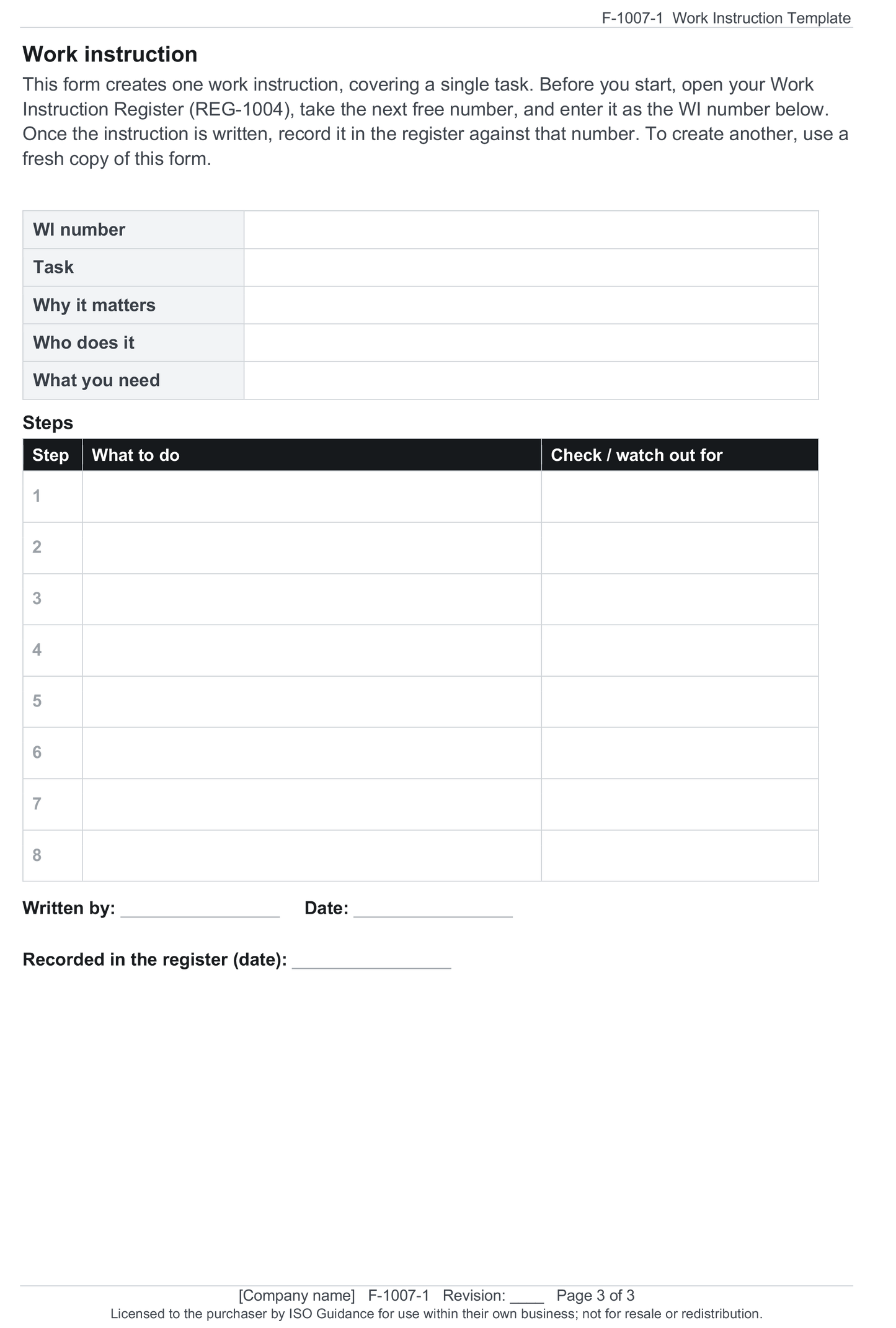
Each copy creates one clear work instruction for a single task. It captures the task, why it matters, who does it and what they need, then lays out the steps in order, each with its own note of what to check or watch out for. It comes with a complete worked example already filled in, an end-of-day clean-down of a coffee machine, so you can see exactly how a good instruction reads before you write your own. You delete the example and build yours underneath.

It supports operational control under clauses 7.5 and 8.1 of ISO 9001. Note: it is designed to sit alongside your operational planning procedure (SOP-1007), your document control procedure (SOP-1001, also available on its own), and a work instruction register (REG-1004) that keeps your instructions numbered and easy to find. Those come together in the complete system, The ISO 9001 Certification-Ready System. The template itself is complete and ready to use on its own.

It is the fastest way to train someone

The real value of a work instruction is not the audit, it is the new starter. A clear, well-written instruction gets a new person doing a tricky job correctly on their first day, instead of shadowing someone for a week or learning by getting it wrong. For a small business where everyone is busy, that is worth the price on its own.

Honest about how few you actually need

Most sellers would push you to document every task you do. We will not, because it is bad advice. A work instruction earns its place only where consistency genuinely matters: a costly mistake, a fiddly job, a task a new starter would struggle with. For everything else, a competent person just gets on with it. The template is built to be used sparingly, because one instruction people actually follow beats twenty gathering dust, and the guidance inside says exactly that.

A worked example shows you the right level of detail

The hardest part of a work instruction is pitching it right: enough detail to be useful, not so much that nobody reads it. The included example, cleaning down a coffee machine, shows that balance perfectly. You see how much to write and how to phrase a step, then follow the same pattern for your own tasks, rather than guessing and either overloading it or leaving gaps.

See the Operator's Take before you buy

Every ISO Guidance document contains a boxed note called The Operator's Take: plain advice from someone who ran real businesses first, then trained as a Lead Auditor. Here is part of the one from this template, word for word.

"Here is the honest truth about work instructions: most small businesses need very few of them, and some barely any. Do not fill one in for every task you do. You will drown in paperwork and none of it will get read. A work instruction earns its place only where getting a task done the same way every time genuinely matters."

That is the difference between a document written by an operator who audits, and one written by an auditor who has never run a business. It is why you end up with a system that actually improves how the business runs, not just one that passes an audit. Fewer mistakes reach your customers, your people spend less time redoing work that went wrong, and the daily friction that wears everyone down quietly drops away. That is what you are really buying: certification you can earn, and a calmer business on the way to it.

A note on where this fits

This is one core document, and it is genuinely useful on its own. A complete, certifiable quality management system is more than any single document: it needs the full set, including the quality manual and the system-level documents. If you decide to go all the way, The ISO 9001 Certification-Ready System brings the whole thing together. This is a sensible step, not the finish line.

Why buy from us

  • Built by a company director, not an auditor. Written by someone who ran real businesses before building management systems, so what you get works in the real world, not just on paper.
  • Written in plain English. No jargon, no clause-speak. If you are new to ISO 9001, it will make sense on day one.
  • The Operator's Take, in every document. Look inside any ISO Guidance document and you will find a boxed note called The Operator's Take: a short, plain comment from someone who has run businesses, explaining why this document actually matters to yours, and how to get real value from it, not just tick a box for an auditor. No other provider gives you this, because it comes from having sat in the chair.
  • Honest, unaccredited, and clear about it. A genuine route to a working system, with no false claims and nothing hidden.

Frequently asked questions

What is a work instruction in ISO 9001?

A work instruction in ISO 9001 is a simple step-by-step guide to a single task, setting out exactly what to do and what to watch out for at each step. Its purpose is to make sure a job that has to be done consistently gets done the same way every time, whoever does it. Work instructions sit below procedures in the system: a procedure describes a whole process, while a work instruction covers one specific task in detail. In plain terms, it is how you capture the right way to do a tricky or important job.

What is the difference between a procedure and a work instruction?

A procedure describes a whole process and how its parts fit together, while a work instruction gives the detailed steps for a single task within it. For example, a purchasing procedure explains how buying works across the business, whereas a work instruction might cover the one fiddly task of setting up a specific machine. Procedures answer what happens and who is responsible; work instructions answer exactly how to do this one job. You need far fewer work instructions than people expect, only where a task genuinely needs to be done the same way every time.

Does ISO 9001 require work instructions?

ISO 9001 does not require work instructions for every task, and many small businesses need only a few or none at all. The standard asks you to control your operations and keep the documented information you actually need, which means writing a work instruction only where the absence of one would risk the work being done wrong. Documenting every task is a common mistake that buries a business in paperwork nobody reads. The right approach is to write instructions sparingly, for the handful of jobs where consistency truly matters.

How do you write a work instruction?

You write a work instruction by focusing on one task and breaking it into clear, ordered steps, each with a note of what to check or watch out for. Start with the task, why it matters, who does it and what they need, then list the steps in the order they happen. Keep the detail at the level a competent person new to that task would need, no more. Working from an example makes this much easier, which is why this template includes a complete worked instruction to follow.

What should a work instruction include?

A work instruction should include the task it covers, why it matters, who carries it out, what they need, and the steps in order with a check or warning against each. Giving it a unique number keeps it controlled and easy to find. It should be detailed enough that someone new to the task can follow it, but short enough that people actually read it. This template captures all of that in a single clear layout, with a worked example showing the right level of detail.

Written by Mike Armstrong, founder of ISO Guidance. Mike ran companies at director level before building management systems, so the systems ISO Guidance writes are built to work in the real world, not just on paper. ISO Guidance helps small and medium sized businesses get ISO certified without a consultant.