Skip to product information
1 of 2

"ISOG have continually under-promised and over-delivered. Outstanding service." Paul J, ATM Security

Quality objectives template

Quality objectives template

$49

Three goals you genuinely track beat the ten you wrote down once and forgot. This is the one page that keeps them honest.

Director-built, not auditor-built
Plain English, no jargon
Instant download, yours to keep

Ask most businesses about their goals and you get nice-sounding phrases. Deliver excellent service. Delight our customers. Words that feel good and change nothing, because nobody ever put a number on them or checked whether they came true.

ISO 9001 asks for something better, and quietly more useful: quality objectives you can actually measure and track.

That sounds like a chore and turns out to be the opposite. A real objective is just a clear goal with a number on it, an owner, and a simple way to see if you are getting there. Fewer late jobs. Fewer complaints. Less rework. Set two or three that genuinely matter, track them honestly, and you have a simple dashboard for whether the business is actually getting better, which is the whole point of a quality system.

Who this is for

This is for any small or medium sized business with an ISO 9001 quality management system that wants to set quality objectives properly, and actually track them, rather than writing down vague goals to satisfy an auditor. If you want a simple way to measure whether the business is genuinely improving, this is it.

View full details

This is F-1002-1, the ISO 9001 quality objectives template: a ready-to-use template written in plain English and prepared to the requirements of the standard.

It gives you one page to set your objectives and track them in the same place. For each objective you record a measurable target, your starting point, who owns it, the date to hit it by, how it is tracked, and your honest progress against it. It comes with a complete worked example already filled in, showing three real objectives, late deliveries, customer complaints and rework, so you can see exactly what a good objective looks like before you set your own. You delete the example and build yours underneath.

It is written to satisfy clause 6.2 of ISO 9001, on quality objectives and planning to achieve them. Note: it is designed to sit alongside your quality manual, your quality policy (POL-1001) and your management review, which live in the complete system, The ISO 9001 Certification-Ready System, and are not part of this purchase. The template itself is complete and ready to use on its own.

It kills the vanity target

The most common mistake with objectives is the nice-sounding goal nobody ever measures, and it is exactly what an assessor sees through in seconds. This template stops you doing it, because every column asks for something real: a number, an owner, a date, a progress update. It forces a goal to be measurable before it can go on the page, which is precisely what turns a wish into an objective.

Set and track in one place

Most businesses set objectives in one document and then lose track of them somewhere else, if they track them at all. Here it is one page for both. You set the target and you update the progress column in the same place, so at any moment you can see where you stand. When your management review comes around, this is the single page you bring to answer, are we actually improving.

A worked example shows you what good looks like

The template arrives with three real objectives already filled in, late deliveries, complaints and rework, each with a target, a tracking method and honest mid-year progress. You are not guessing what a good objective looks like, you are copying a pattern that already works, and adapting it to the numbers that matter in your business.

See the Operator's Take before you buy

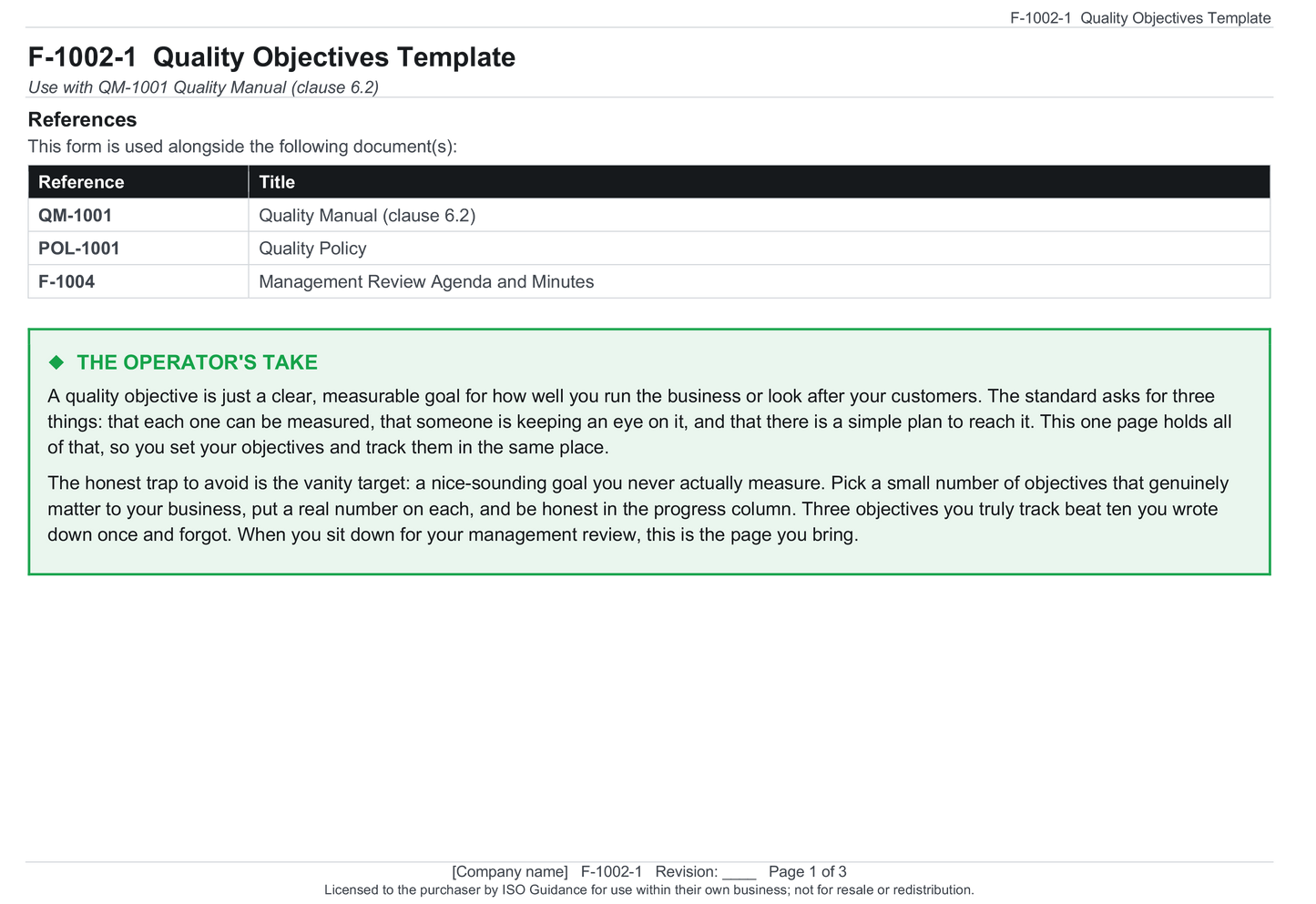
Every ISO Guidance document contains a boxed note called The Operator's Take: plain advice from someone who ran real businesses first, then trained as a Lead Auditor. Here is part of the one from this template, word for word.

"The honest trap to avoid is the vanity target: a nice-sounding goal you never actually measure. Pick a small number of objectives that genuinely matter to your business, put a real number on each, and be honest in the progress column. Three objectives you truly track beat ten you wrote down once and forgot."

That is the difference between a document written by an operator who audits, and one written by an auditor who has never run a business. It is why you end up with a system that actually improves how the business runs, not just one that passes an audit. Fewer mistakes reach your customers, your people spend less time redoing work that went wrong, and the daily friction that wears everyone down quietly drops away. That is what you are really buying: certification you can earn, and a calmer business on the way to it.

A note on where this fits

This is one core document, and it is genuinely useful on its own. A complete, certifiable quality management system is more than any single document: it needs the full set, including the quality manual and the system-level documents. If you decide to go all the way, The ISO 9001 Certification-Ready System brings the whole thing together. This is a sensible step, not the finish line.

Why buy from us

  • Built by a company director, not an auditor. Written by someone who ran real businesses before building management systems, so what you get works in the real world, not just on paper.
  • Written in plain English. No jargon, no clause-speak. If you are new to ISO 9001, it will make sense on day one.
  • The Operator's Take, in every document. Look inside any ISO Guidance document and you will find a boxed note called The Operator's Take: a short, plain comment from someone who has run businesses, explaining why this document actually matters to yours, and how to get real value from it, not just tick a box for an auditor. No other provider gives you this, because it comes from having sat in the chair.
  • Honest, unaccredited, and clear about it. A genuine route to a working system, with no false claims and nothing hidden.

Frequently asked questions

What are quality objectives in ISO 9001?

Quality objectives in ISO 9001 are clear, measurable goals for how well you run the business or look after your customers, such as fewer late deliveries or fewer complaints. The standard asks that each one can be measured, that someone is responsible for it, and that there is a plan to achieve it. They fall under clause 6.2. In plain terms, they are the handful of specific things you are trying to improve, with a number on each so you can tell whether you are getting there.

What is clause 6.2 of ISO 9001?

Clause 6.2 of ISO 9001 requires you to set quality objectives and plan how to achieve them. It asks that objectives are consistent with your quality policy, measurable, monitored, communicated and updated as needed, and that you plan what will be done, with what resources, by whom and by when, and how results will be evaluated. This quality objectives template is written to satisfy clause 6.2 by holding the objective and its plan on a single page.

What are examples of quality objectives?

Good quality objectives are specific and measurable, such as reducing late deliveries to no more than ten a year, keeping customer complaints below five, or halving the rate of reworked jobs. Each pairs a clear target with a way to measure it and a date to reach it by, rather than a vague aim like improve customer satisfaction. This template includes three worked examples of exactly this kind, so you can see the difference between a real objective and a vanity target before setting your own.

How do you measure quality objectives?

You measure quality objectives by choosing a number you can actually count and deciding where that number comes from and how often you will check it. For example, late jobs counted from your job records and reviewed monthly, or complaints taken from your complaint log. The key is that the measure is honest and repeatable, so progress is a fact rather than an opinion. This template gives each objective its own tracking method and progress column so measurement is built in from the start.

Does ISO 9001 require quality objectives?

Yes, ISO 9001 requires quality objectives, set out in clause 6.2, and they are one of the things an assessor will always look for. The standard expects them to be measurable, monitored and supported by a plan to achieve them, not just written down and forgotten. Setting a small number of genuine objectives and tracking them honestly is both a requirement and one of the most useful habits a quality system gives you, because it turns improvement into something you can actually see.

Written by Mike Armstrong, founder of ISO Guidance. Mike ran companies at director level before building management systems, so the systems ISO Guidance writes are built to work in the real world, not just on paper. ISO Guidance helps small and medium sized businesses get ISO certified without a consultant.