ISO Guidance
ISO 9001 gap analysis and self-assessment tool
ISO 9001 gap analysis and self-assessment tool
Couldn't load pickup availability
Someone has told you that you need ISO 9001. A customer, a bigger contract, a tender you want to win. And the moment you start reading about it, your heart sinks.
It looks like a mountain of paperwork. Clauses, procedures, audits, terms you have never used. It looks like exactly the sort of thing that gets in the way of running the business rather than helping you run it. You have a company to keep moving, and now there is this.
Before you spend a penny or an evening on any of it, there is one sensible first move. Find out how much of it you already do.
What this actually is
This is a gap analysis. That is a plain-English term for a simple exercise: you compare how your business runs today against what ISO 9001 asks for, and you find the gaps between the two.
You do it yourself, at your own desk, in your own time. The tool asks you straightforward questions about how your business really works. You answer them honestly. At the end you are holding a clear written picture of three things: what you already do well, what you do but could tighten up, and what is genuinely missing.
No jargon you need a dictionary for. No consultant sitting across the desk. Just an honest look at your own business, section by section.
What it gives you, before certification even comes into it
Here is the part nobody tells you. A good gap analysis is worth doing even if you never chase a certificate.
Because the questions are about how your business actually operates, the answers show you where you are exposed right now. The job only one person knows how to do, and what happens the week they are off sick. The suppliers nobody has checked in years. The complaints that get sorted but never counted, so the same one keeps coming back. The decisions made twice because the first one was never written down.
None of that is about passing an audit. All of it is costing you time, money or customers today. This tool drags it into the light so you can deal with it.
The part no competitor can copy
Most ISO material is written by people who came up through auditing. They can tell you what the standard demands. They cannot tell you why it matters to a business, because they have never run one.
Mike Armstrong came the other way round. He ran companies at director level before he ever built a management system. In his words: “I sweated the cashflow and carried the P&L, and I was sceptical of anything that looked like paperwork for its own sake.”
So every ISO Guidance document carries something you will not find anywhere else. It is called The Operator’s Take. A recurring boxed note, in Mike’s own voice, that sits alongside each part of the standard and tells you, from experience, why it earns its place in a real business. Not what the clause says. What Mike learned about it from actually running companies.
An example of the kind of note you will find inside this tool:
The Operator’s Take
When I first did one of these on my own business, my instinct was to tick “we do that” and move on. What I found, when I made myself slow down, was that the areas I was quickest to wave through were usually the ones quietly costing me. That is not a rule, and your business is not mine, so take it as one operator’s experience rather than gospel. But if a section feels too easy, it is worth a second, harder look. That is often where the useful stuff is hiding.
That is Mike’s lived experience, built into the document. No template mill can fake it, because it does not come from reading the standard. It comes from having run the businesses.
Get the gap analysis toolSo then, and only then, there is the certificate
Once you have your written list of gaps, the road to certification stops being a mystery. You know exactly what stands between you and ISO 9001, in order, with nothing hidden. Most owners are relieved to find the list is far shorter than they feared, because a functioning business already does much of what the standard asks. It simply was never written down.
Who this is for
- You have been told you need ISO 9001 and you have no idea how big the job is.
- You want a straight answer before you spend money on documents or an assessment.
- You would rather understand your own business than pay someone to explain it back to you.
Who this is not for
- Anyone who wants it done for them. This is a tool you run, not a service performed on you. If you want the whole system built around your business, that is a different route.
- Anyone hoping to be told they are already fine. The tool is only worth having because it tells you the truth.
What is inside
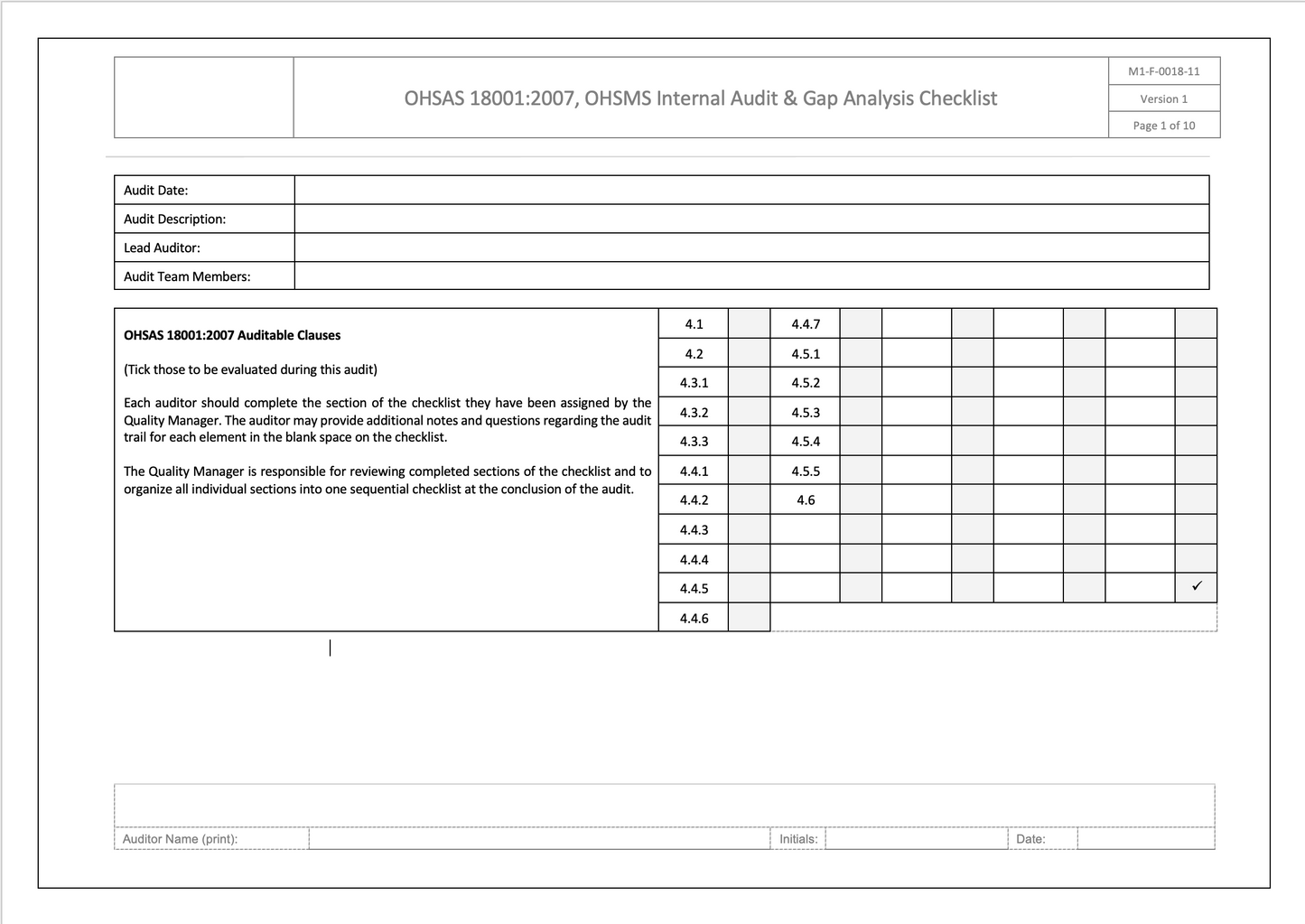
It works as a structured ISO 9001 gap analysis checklist, covering every area of your business that ISO 9001 expects you to have a grip on, one section at a time, in plain English, with room to record your answer and your next action against each one. And The Operator’s Take runs all the way through it.
PENDING 2026: exact contents, section count, question count, page length and file format are confirmed after ISO 9001:2026 publishes on 16 September 2026 and the final document is authored. Mike has confirmed these are a simple drop-in at that point.
The price
$79.
A consultant will happily do this for you. It is normally the first billable stage of a job that runs into thousands, and at the end they walk out with everything they learned about your business. You get a report.
Seventy nine dollars, and you keep the understanding, because you are the one who did the work.
Free with your purchase: The Road to Certification
Every purchase, this tool included, comes with a free guide called The Road to Certification. It is Mike’s honest account of the whole journey, from where you are standing right now to a certificate on the wall, written in plain business language.
It shows you the real road, so you can see what comes after this first step and decide how far you want to go, at your own pace. No hype, no pressure. Just a straight map from someone who has walked it.
Find out exactly where you stand. $79.Frequently asked questions
What is an ISO 9001 gap analysis?
An ISO 9001 gap analysis is a simple comparison between what the standard asks for and what your business already does, which gives you a written list of the gaps you need to close. It is normally the first thing anyone does on the road to ISO 9001, because it tells you the size of the job before you commit money or time. A good deal of what the standard asks for, you will already be doing without calling it that. The analysis gives you full credit for those and isolates the genuine work.
How do you carry out an ISO 9001 gap analysis?
You work through each area of the standard in turn and record honestly whether your business fully meets it, partly meets it, or does not address it at all. The work is not difficult, but it depends entirely on the right questions being asked in the right order, which is what this tool gives you. Answer as your business runs today, not as you intend it to run. An optimistic gap analysis is worse than none at all, because it hides the work instead of revealing it.
Are free ISO 9001 gap analysis checklists good enough?
A free checklist will usually give you the clause numbers but not what they mean for a business your size, which is the part that actually decides whether you pass. Most are the standard’s contents page reformatted into a spreadsheet, written for auditors rather than for the owner being audited, so you are left translating compliance language on your own. If your budget is genuinely zero, a free checklist beats nothing. If you intend to be certified, you want the questions in language you can answer without a dictionary, and the plain-English reason each one matters to your business.
Do I need a gap analysis before ISO 9001 certification?
No, a gap analysis is not a requirement of ISO 9001, but skipping it usually costs more than it saves. Certification assesses your operating system against the standard, and the most common reason small and medium sized businesses stall is that nobody knew what was missing until an outsider pointed it out. A gap analysis moves that discovery to the beginning, where it is cheap to fix, instead of the end, where it is not.
What will an ISO 9001 gap analysis show me?
It shows you three things: what already meets the standard, what partly meets it and needs tightening, and what does not exist yet and has to be created. That third list is your work plan and your buying list. In most small and medium sized businesses it is far shorter than people fear, because a working company is already doing much of what ISO 9001 asks. It simply has not been written down.
What format is the ISO 9001 gap analysis template, and can I edit it?
It is supplied as an editable Microsoft Office file, a working ISO 9001 gap analysis template you complete yourself, so you can work in it directly, save your answers and return to it as you close each gap. Keeping your completed copy matters, because it becomes your baseline and your record of progress. Nothing is locked, watermarked or time limited. Once you have bought it, it is yours.
Where it leads next
Almost nobody reaches the end and finds nothing. That is normal, and it is why the next steps already exist.
- See how ISO 9001 certification actually works, start to finish.
- What ISO 9001 actually requires, in plain English.
- Get certified without a consultant.
- The complete ready-to-implement system.
About the author
Written by Mike Armstrong, founder of ISO Guidance. Mike ran companies at director level before building management systems, so the systems ISO Guidance writes are built to work in the real world, not just on paper. ISO Guidance helps small and medium sized businesses get ISO certified without a consultant.
Share