Skip to product information
1 of 1

"ISOG have continually under-promised and over-delivered. Outstanding service." Paul J, ATM Security

Equipment calibration register

Equipment calibration register

$49

If a wrong reading could let a bad job through, this is how you prove your kit can be trusted. If it could not, you may not need this at all.

Director-built, not auditor-built
Plain English, no jargon
Instant download, yours to keep

Some businesses live or die by their measurements. If you build to spec, torque to a figure, hold a temperature or pass or fail a part on a gauge, then a piece of equipment drifting out of true can quietly wave bad work straight through. Nobody notices until a customer does.

ISO 9001 asks a fair question about that kit: how do you know it is still accurate? This register is the simple answer. One list, kept current, showing what each piece of equipment is, when it was last checked, when it is due again, and whether it passed.

And here is the honest part most sellers would not tell you. If your business does not rely on measuring equipment to prove your work is right, you probably do not need this at all, and you should not invent a use for it. This page will help you decide, then give you exactly what you need if the answer is yes.

Who this is for

This is for any small or medium sized business whose work depends on measuring equipment being accurate: gauges, torque wrenches, thermometers, test equipment, levels, anything where a wrong reading could let a bad job through. If a customer trusts a number you measured, you need to be able to show that number can be trusted. If you do not use equipment like that, you can safely skip this one.

View full details

This is REG-1003, the ISO 9001 equipment calibration register: a ready-to-use register written in plain English and prepared to the requirements of the standard.

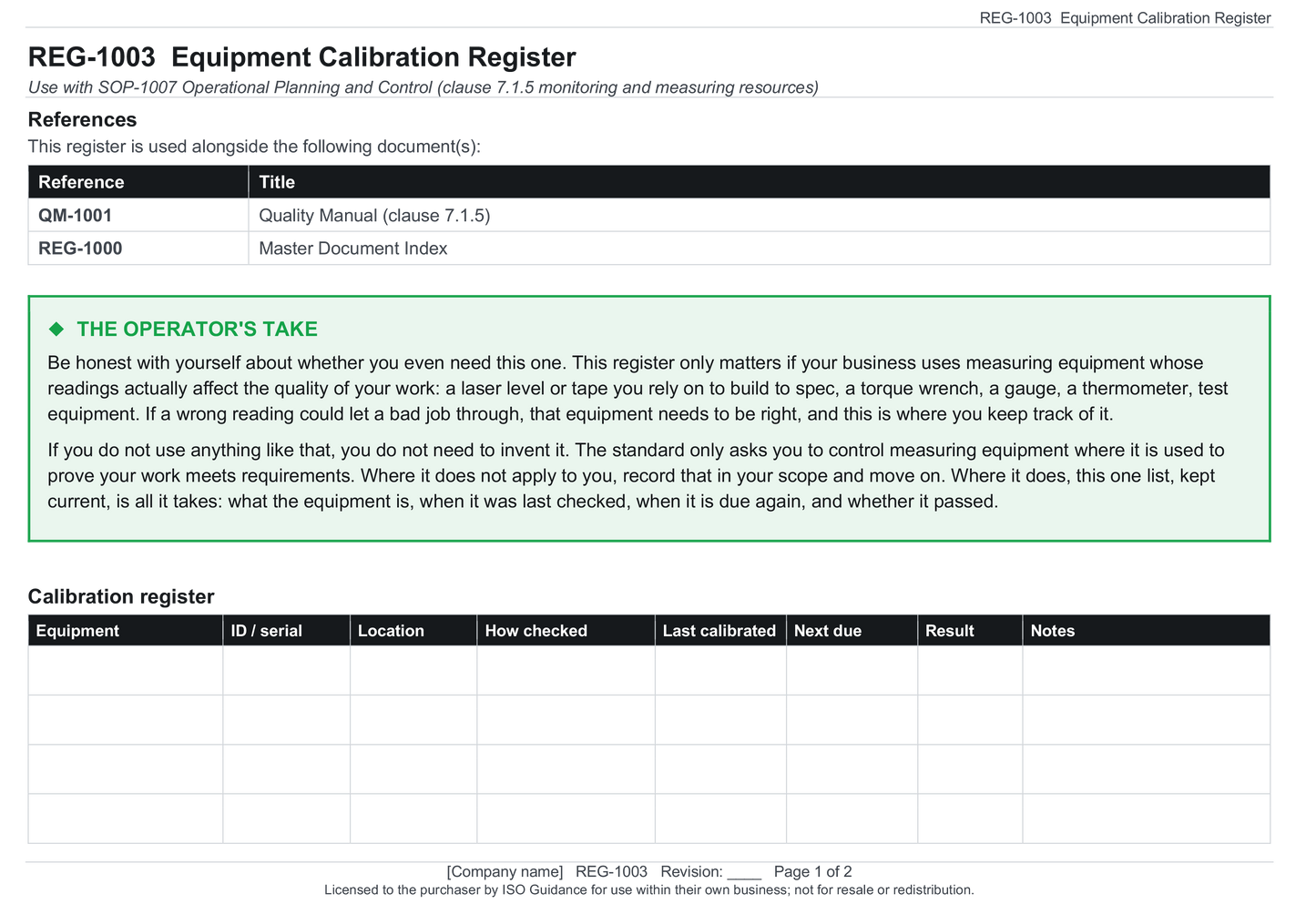
It gives you a single, clear list to keep track of every piece of measuring equipment whose accuracy affects your work. For each item you record what it is, its identifying number, where it lives, how it is checked, when it was last calibrated, when it is next due, and whether it passed. That is all it takes to show an assessor, at a glance, that the equipment you rely on is kept accurate and in date.

It is written to support clause 7.1.5 of ISO 9001, on monitoring and measuring resources. Note: it is designed to sit alongside your quality manual and your master document index (REG-1000). Those live in the complete system, The ISO 9001 Certification-Ready System, and are not part of this purchase. The register itself is complete and ready to use on its own.

It answers the one question an assessor will ask about your kit

If your work depends on measurements, an assessor will want to know your equipment is still accurate and how you can prove it. This register is that proof, in one place, kept current, so the question is answered before it is even asked. No hunting for calibration certificates, no vague assurances, just a clear list showing every item is in date and passing.

Honest about whether you even need it

Most sellers would happily sell you a document you do not need. We would rather you bought the right things. This register only matters if you use measuring equipment whose readings affect your quality. If you do, it is essential and this is exactly what you need. If you do not, the honest answer is to record that in your scope and skip it, and the guidance inside the document says exactly that.

As simple as a register should be

There is nothing to learn here. It is one table, laid out with the right columns already in place, ready for you to list your equipment and keep it up to date. The whole discipline comes down to one habit: check the due dates, keep the list current, and you have satisfied this part of the standard without fuss.

See the Operator's Take before you buy

Every ISO Guidance document contains a boxed note called The Operator's Take: plain advice from someone who ran real businesses first, then trained as a Lead Auditor. Here is part of the one from this register, word for word.

"This register only matters if your business uses measuring equipment whose readings actually affect the quality of your work: a laser level or tape you rely on to build to spec, a torque wrench, a gauge, a thermometer, test equipment. If a wrong reading could let a bad job through, that equipment needs to be right, and this is where you keep track of it. If you do not use anything like that, you do not need to invent it."

That is the difference between a document written by an operator who audits, and one written by an auditor who has never run a business. It is why you end up with a system that actually improves how the business runs, not just one that passes an audit. Fewer mistakes reach your customers, your people spend less time redoing work that went wrong, and the daily friction that wears everyone down quietly drops away. That is what you are really buying: certification you can earn, and a calmer business on the way to it.

A note on where this fits

This is one core document, and it is genuinely useful on its own. A complete, certifiable quality management system is more than any single document: it needs the full set, including the quality manual and the system-level documents. If you decide to go all the way, The ISO 9001 Certification-Ready System brings the whole thing together. This is a sensible step, not the finish line.

Why buy from us

  • Built by a company director, not an auditor. Written by someone who ran real businesses before building management systems, so what you get works in the real world, not just on paper.
  • Written in plain English. No jargon, no clause-speak. If you are new to ISO 9001, it will make sense on day one.
  • The Operator's Take, in every document. Look inside any ISO Guidance document and you will find a boxed note called The Operator's Take: a short, plain comment from someone who has run businesses, explaining why this document actually matters to yours, and how to get real value from it, not just tick a box for an auditor. No other provider gives you this, because it comes from having sat in the chair.
  • Honest, unaccredited, and clear about it. A genuine route to a working system, with no false claims and nothing hidden.

Frequently asked questions

What is a calibration register in ISO 9001?

A calibration register in ISO 9001 is a simple list of the measuring equipment your work depends on, showing when each item was last calibrated, when it is next due, and whether it passed. Its job is to prove that the equipment used to judge whether your work meets requirements is kept accurate and in date. It supports clause 7.1.5 on monitoring and measuring resources. In plain terms, it is how you show an assessor that the tools you trust your numbers to can actually be trusted.

Does ISO 9001 require calibration?

ISO 9001 requires calibration only where you use measuring equipment to prove your work meets requirements, not for every tool you own. Clause 7.1.5 asks you to make sure such equipment is fit for purpose and, where measurement accuracy matters, that it is calibrated or verified against a known standard and kept in a suitable state. If your business does not rely on measurement to demonstrate conformity, you can record that in your scope and the requirement does not apply. Where it does apply, a calibration register is the simplest way to meet it.

What is clause 7.1.5 of ISO 9001?

Clause 7.1.5 of ISO 9001 covers monitoring and measuring resources, meaning the equipment you use to check that your products or services meet requirements. It asks you to provide suitable equipment, keep it fit for purpose, and where accuracy matters, calibrate or verify it against a traceable standard, keep records, and protect it from damage or drift. This calibration register is written to help a small or medium sized business satisfy that clause with a single, current list.

What equipment needs to be calibrated for ISO 9001?

Only equipment whose readings affect whether your work meets requirements needs to be calibrated for ISO 9001. That typically means things like gauges, torque wrenches, thermometers, pressure and test equipment, and measuring tools you build or inspect to. Equipment used only for rough guidance, where the reading does not decide whether a job passes, generally does not need calibrating, though it is sensible to mark it as such. The test is simple: if a wrong reading could let a bad job through, it belongs on your calibration register.

How often should equipment be calibrated?

Equipment should be calibrated at intervals suitable for how it is used, how much it drifts, and how critical its readings are, rather than to a single fixed rule. Many businesses calibrate important equipment annually, but heavily used or critical items may need it more often, and the manufacturer's guidance is a sensible starting point. What matters to an assessor is that you have set a sensible interval, that you keep to it, and that your register shows what is due and when. This register makes those due dates easy to see and keep on top of.

Written by Mike Armstrong, founder of ISO Guidance. Mike ran companies at director level before building management systems, so the systems ISO Guidance writes are built to work in the real world, not just on paper. ISO Guidance helps small and medium sized businesses get ISO certified without a consultant.